Why Oneleet and Sprinto end up on the same shortlist
Oneleet and Sprinto tend to appear together when a company has outgrown spreadsheets for its first SOC 2 or ISO 27001 and wants more than a plain evidence tool. They answer that wish in opposite directions. Sprinto puts more of the work into software, so the compliance programme keeps itself current with less manual effort. Oneleet puts more of it into people, so someone tests and hardens your systems while the programme runs. Neither is a lighter version of the other.
The clearest way to read all three options is through one question: how much of the security is done for you, and when. Sprinto automates the compliance programme and leaves the security work it tracks to your team. Oneleet adds the testing and hardening. Qalea adds the part that runs between audits: watching the systems and responding when an alert fires. This comparison sets out what each does well, what kind of company each is built for and where each one stops, and leaves the decision to the reader.
The three at a glance
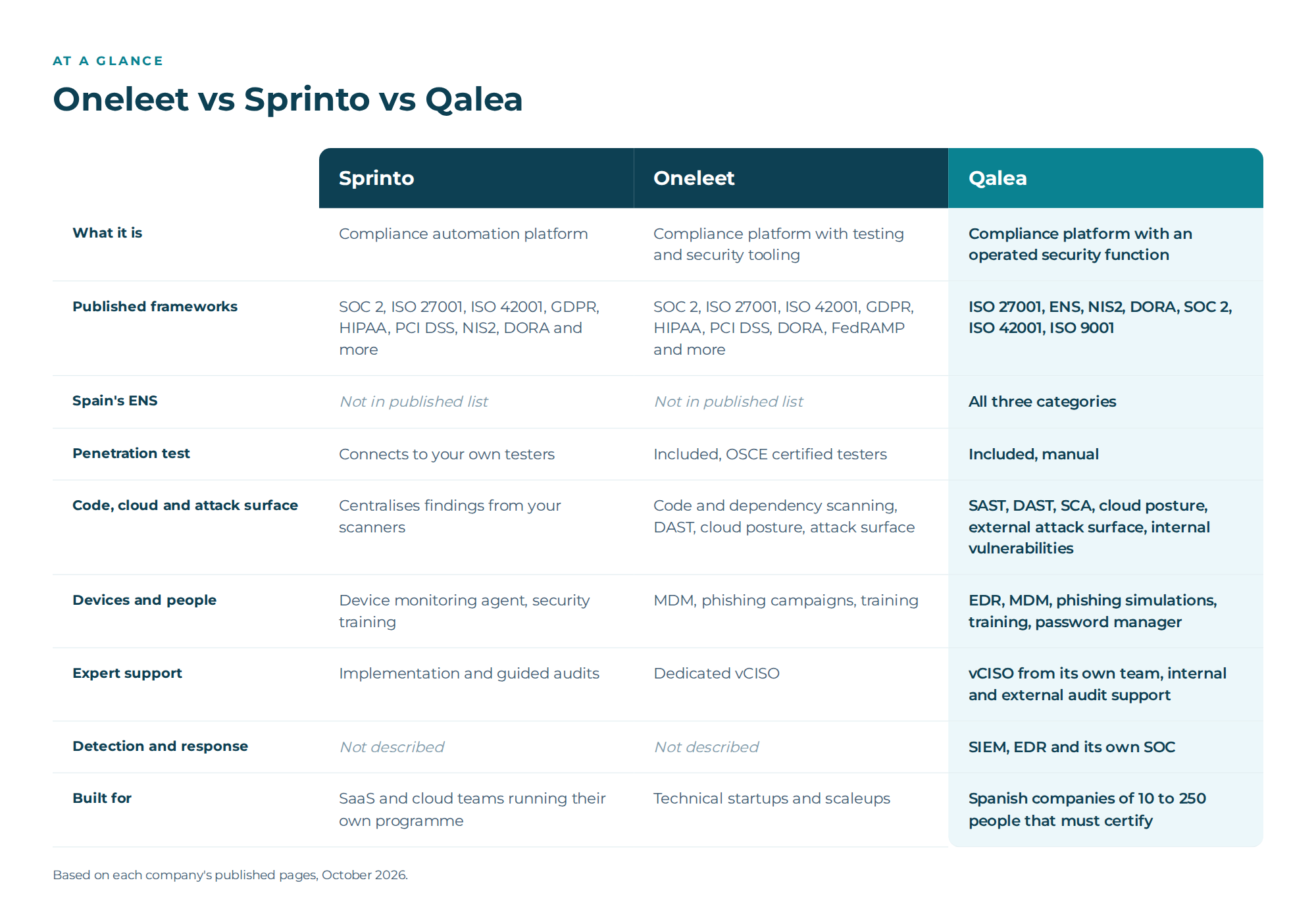
Sprinto is a compliance automation platform. Oneleet is a compliance platform with penetration testing, scanning and a vCISO built into the offer. Qalea is a compliance platform paired with an operated security function that also monitors and responds. The table reflects each company's published pages as of October 2026.
Sprinto: compliance run by software
What it does well
Sprinto is a compliance automation platform with offices in San Francisco and Bengaluru. It connects to cloud, identity, HR and code systems, collects evidence, monitors controls and maps one set of evidence to several frameworks, which is its strongest technical argument. In its March 2026 launch announcement, Sprinto reports more than 3,000 customers in 75 countries and more than 300 integrations. Its framework catalogue runs to more than 200 standards, including SOC 2, ISO 27001, ISO 42001, GDPR, HIPAA and PCI DSS, and Sprinto also publishes NIS2 and DORA programmes.
Around that core sit a risk register, vendor risk management, a Trust Center, automated answers to security questionnaires, a device monitoring agent and security training. Sprinto's own experts help with implementation, migration and guided audits.
Who it is built for
Sprinto fits SaaS and cloud companies that want to run their own compliance programme, often across several frameworks at once, with as little manual work as possible. The typical buyer is a compliance, IT or GRC lead who wants a system that keeps the programme current and the evidence ready for the auditor.
What it has announced
In March 2026 Sprinto launched what it calls the Autonomous Trust Platform: governed agents that detect changes across systems, vendors and access, refresh evidence, run vendor due diligence and resolve control gaps on their own. We have not yet found independent evidence, such as customer reviews or case studies, of those agents closing gaps on their own in production, so the announcement is best read as stated direction rather than demonstrated capability.
Where its scope stops
Sprinto prepares the programme and the evidence; the security work underneath stays with the customer. Its vulnerability module centralises findings from your scanners and penetration test reports, and Sprinto describes connecting to the testers you already use rather than running the test itself. Its published offering does not describe a vCISO, a SOC or incident response. Spain's Esquema Nacional de Seguridad (ENS) does not appear among the frameworks it publishes.
Oneleet: compliance with the security tested
What it does well
Oneleet was founded in 2022 by career penetration testers and went through Y Combinator. Its platform automates evidence and control monitoring, and around it Oneleet puts the security work most compliance tools leave out. According to its product pages, every programme includes a manual penetration test by OSCE certified testers, alongside code and dependency scanning, dynamic application testing, cloud posture checks on AWS, GCP and Azure, attack surface monitoring, device management, phishing campaigns and access reviews. A dedicated vCISO, reachable in Slack, shapes the programme and manages the auditor, and Oneleet's SOC 2 packages include the audit by an independent AICPA firm.
Its published frameworks include SOC 2, ISO 27001, HIPAA, PCI DSS, GDPR, CIS IG1, NIST 800-171 and DORA, with ISO 42001 and FedRAMP shown on its homepage, plus custom frameworks.
Who it is built for
Oneleet fits technical startups and scaleups, usually selling software to demanding enterprise customers, that want the certificate to mean the product has actually been tested. The typical buyer is a CTO or technical founder who would rather sign one contract than assemble a pentest firm, a scanner, a device management tool and a consultant.
What it has announced
Oneleet's homepage now describes an AI agent that prepares fixes for each gap, with a Oneleet expert verifying every fix, and promises continuous pentesting rather than a yearly test. We have not yet found independent evidence of the agent or of continuous pentesting running in customer environments, so both are best read as stated direction. The manual pentest and the vCISO are the parts that reviewers describe today.
Where its scope stops
Oneleet tests and hardens the security; its published products do not include watching it. They do not describe a SIEM, endpoint detection and response, or a SOC that triages alerts and responds to incidents, so that function sits with the customer's team or another provider. Device management configures and checks laptops; it does not detect an attack running on them. ENS and NIS2 do not appear among the frameworks Oneleet publishes; DORA does.
How much of the vCISO a customer actually gets is worth checking on the demo. Oneleet describes a dedicated person reachable in Slack; an independent pricing analysis by ComplyJet describes the vCISO hours included in its packages as limited; and Oneleet's homepage now routes most gap fixing through its AI, with an expert approving each fix.
Oneleet and Sprinto: two answers to the same requirement
Both start from the same moment: a customer asks for SOC 2 or ISO 27001 and the company needs a way to get there and stay there. Sprinto answers by taking manual work out of the programme, so integrations and agents keep the evidence current while the customer's team stays in charge. Oneleet answers by putting security people into the programme, so someone tests the application, someone guides the controls and someone handles the auditor.
The difference shows in the buyer. Sprinto's typical buyer owns compliance and wants a system to run it. Oneleet's typical buyer owns the product and wants it to be secure without managing a stack of vendors. Neither model is better in the abstract; they answer different organisations.
Testing the security is not the same as watching it
A penetration test examines a system at one moment, and hardening closes what the test finds. Both matter. But the frameworks these companies certify against also require security that runs continuously between those moments.
ISO 27001:2022 includes Annex A control 8.16, which requires networks, systems and applications to be monitored for anomalous behaviour, and controls 5.24 to 5.26 on preparing for, assessing and responding to security incidents. The SOC 2 criteria CC7.2 to CC7.4 ask the same: monitor for anomalies, evaluate security events and respond to incidents. NIS2 lists incident handling among the measures in article 21(2)(b) of Directive (EU) 2022/2555 and sets an early warning within 24 hours in article 23. Spain's ENS, under Royal Decree 311/2022, includes the system monitoring measures in op.mon from the Basic category upwards.
In a SOC 2 Type II examination or an ISO 27001 surveillance audit, the auditor samples evidence from across the period: the alerts raised, who reviewed them and how incidents were closed. That trail exists only if someone produced it. We cover the gap between a documented control and an operated one in what a certification audit actually tests, and the clocks that start when an incident is detected in NIS2 and DORA incident reporting deadlines.
So the useful question for any of the three is concrete: when an alert fires at three in the morning on a Saturday, who sees it, and what happens next? On their published offerings, Sprinto and Oneleet leave that answer to the customer's own team or another provider. It is the same boundary we describe in what a compliance platform does not do, drawn one step further out.
Where Qalea fits, and where it does not
Qalea is a compliance platform and an operated security function, delivered as one service. Put side by side, it covers the strongest parts of both of the others for the frameworks a Spanish company has to certify. From the Sprinto side: automated evidence, control reuse across frameworks, risk and supplier management, security questionnaires and a Trust Center. From the Oneleet side: a manual penetration test, application and cloud security scanning, attack surface management and device management. On top of both, it adds a vCISO from Qalea's own security team, direct support through the internal audit and the external audit, and the detection and response that runs between audits.
One management system for every framework. Qalea's platform is a digital ISMS for ISO 27001, ENS at all three categories, NIS2, DORA, SOC 2, ISO 42001 and ISO 9001, reusing controls and evidence across them. Evidence is collected automatically from Google Workspace, Microsoft 365, AWS, GCP, Azure, GitHub, GitLab, Bitbucket and Slack, and the platform manages risks, suppliers, customer security questionnaires and a Trust Center, keeping the programme continuously ready for audit.
Testing and hardening. A manual penetration test; application security from commit to runtime with SAST, DAST, SCA, secrets scanning and SBOM; external attack surface management; internal vulnerability management across servers and hosts; misconfiguration detection on AWS, GCP and Azure; device management, phishing simulations, continuous training and a password manager.
Watching and responding. A SIEM that centralises events, EDR across Windows, macOS and Linux laptops and servers, and Qalea's own SOC, which triages alerts and responds to incidents. When the auditor samples logs and incident trails from different months, those records exist because someone has been producing and reviewing them.
Judgement and support. A vCISO provides senior judgement on architecture and customer questionnaires, and can act as the Security Officer that ENS article 11 requires to be separate from system operation. Support is sized to the customer's team: Supported includes onboarding and unlimited support, Guided adds the internal audit, and Fully Managed absorbs the operational load of the programme, including support during the external audit.
Qalea is built for Spanish companies of 10 to 250 people that have to certify: a company answering a public tender that requires ENS, a regulated company adding NIS2 or DORA to an existing programme, or a company whose certification project has stalled. Qalea is itself certified to ENS at High category. It works with more than 80 clients won in two years, with churn below 1%, has raised US$1.5 million in total funding to date, and was selected for the 2025 cohort of Google for Startups Growth Academy: AI for Cybersecurity, one of 16 startups worldwide.
The honest boundaries matter as much as the fit. Qalea is not a catalogue of two hundred frameworks; it covers the frameworks a midsized Spanish company has to certify and operates the security underneath them. HIPAA and FedRAMP are outside its current scope. And like Sprinto and Oneleet, Qalea does not issue certificates and is not a certification body: it gets the organisation ready for audit and runs the security function that keeps the certificate valid.
Who each is built for
Sprinto is built for SaaS and cloud companies that want to run their own compliance programme across several frameworks with as little manual work as possible, and that have people in place to do the security work the platform tracks.
Oneleet is built for technical startups and scaleups that want a tested product and a security expert guiding the programme in one contract, and that handle detection and response themselves or through another provider.
Qalea is built for Spanish companies of 10 to 250 people that have to certify, including ENS for public tenders, without an internal team to operate the controls, and for regulated companies adding NIS2 or DORA that want the security operated alongside the programme.
Four questions to ask on any demo
- Who operates the controls between audits, and who signs off that they ran?
- When an alert fires on a Saturday night, who sees it and what happens next?
- How many hours of a named person's time does the expert support include, and how much of it runs through AI?
- Are the frameworks your customers and tenders ask for, including ENS at the category required, in the published list?
These work on any demo, Qalea's included.
For the wider market, including the Spanish ENS specialists and security providers, see Best Compliance Automation Platforms for Spain in 2026. For the two largest platforms side by side, see Vanta vs Drata vs Qalea.