Two questions that decide it, before you compare any platform
Most compliance software comparisons rank tools on a long list of features. For a company in Spain, that is the wrong place to start, because two questions settle the shortlist before feature depth matters at all.
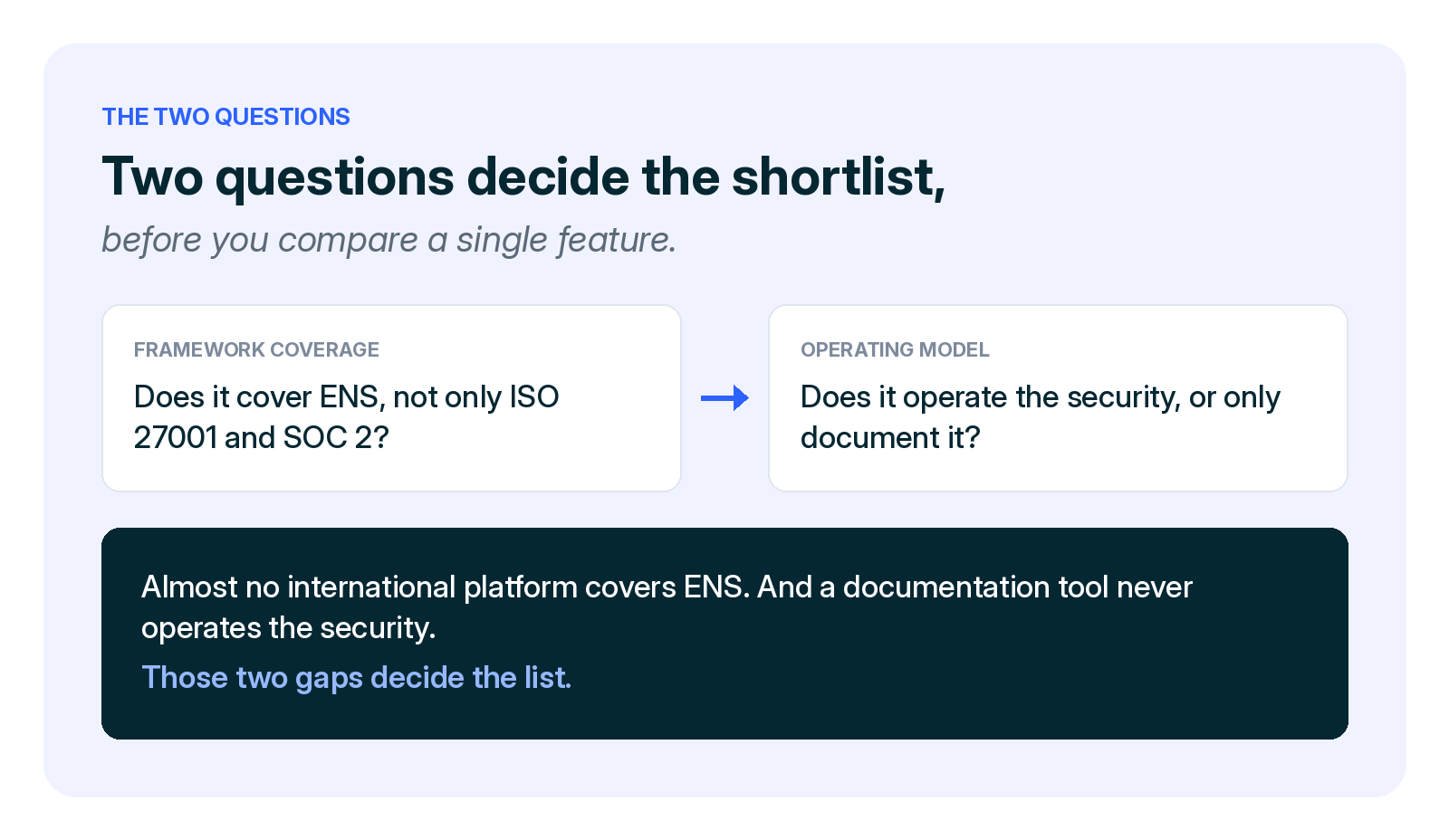
The first is coverage. Which framework unblocks your next deal or tender? If you sell to United States customers, that is SOC 2. If you sell to Spanish or European customers, it is usually ISO 27001. If you want to supply the Spanish public sector, it is the Esquema Nacional de Seguridad (ENS), governed by Real Decreto 311/2022, with three categories (básica, media, alta) and its own control catalogue. ENS has no equivalent in the SOC 2 world, and almost no international platform carries it. Buy a tool that does not cover the framework your buyer is asking for and the feature list is irrelevant.
The second is the operating model. A compliance platform automates the documentation: it maps controls, keeps your Statement of Applicability and risk register current, and collects evidence from your systems. What it does not do is run the security those controls describe. When the auditor tests whether a control operates, or a client sends a security questionnaire, or an alert fires at two in the morning, a documentation tool has nothing to say. Someone has to operate the security. The question is whether that someone comes with the platform, or whether it is you.
Hold those two questions in mind, because they cut the market into groups that each solve one half of the problem, and rarely both.
What compliance automation actually does, and where it stops
Compliance automation is genuinely useful. It replaces spreadsheets and screenshots with software that connects to your cloud, identity and code systems, maps the evidence to a framework, and flags drift when a control slips. For a documentation-heavy standard, that removes months of manual effort.
The limit is structural, not a criticism of any one product. Automation produces the artefacts an auditor reviews. It does not produce the outcomes an auditor tests. ISO 27001 clauses 4 to 10 and the ENS control catalogue both assume an operating security function: someone triaging alerts, running the penetration test, patching what it finds, answering the client questionnaire, and exercising judgement when a control does not fit the business. The Stage 2 audit checks that those things happen. The surveillance audit checks again a year later.
So a company with no internal security team can buy the best automation platform on the market and still arrive at the audit with a complete evidence pack sitting on top of controls that nobody operates. The certificate is not won by the pack. It is won by the function underneath it. With that in mind, here is how the platforms actually divide.
The compliance platforms: built for documentation
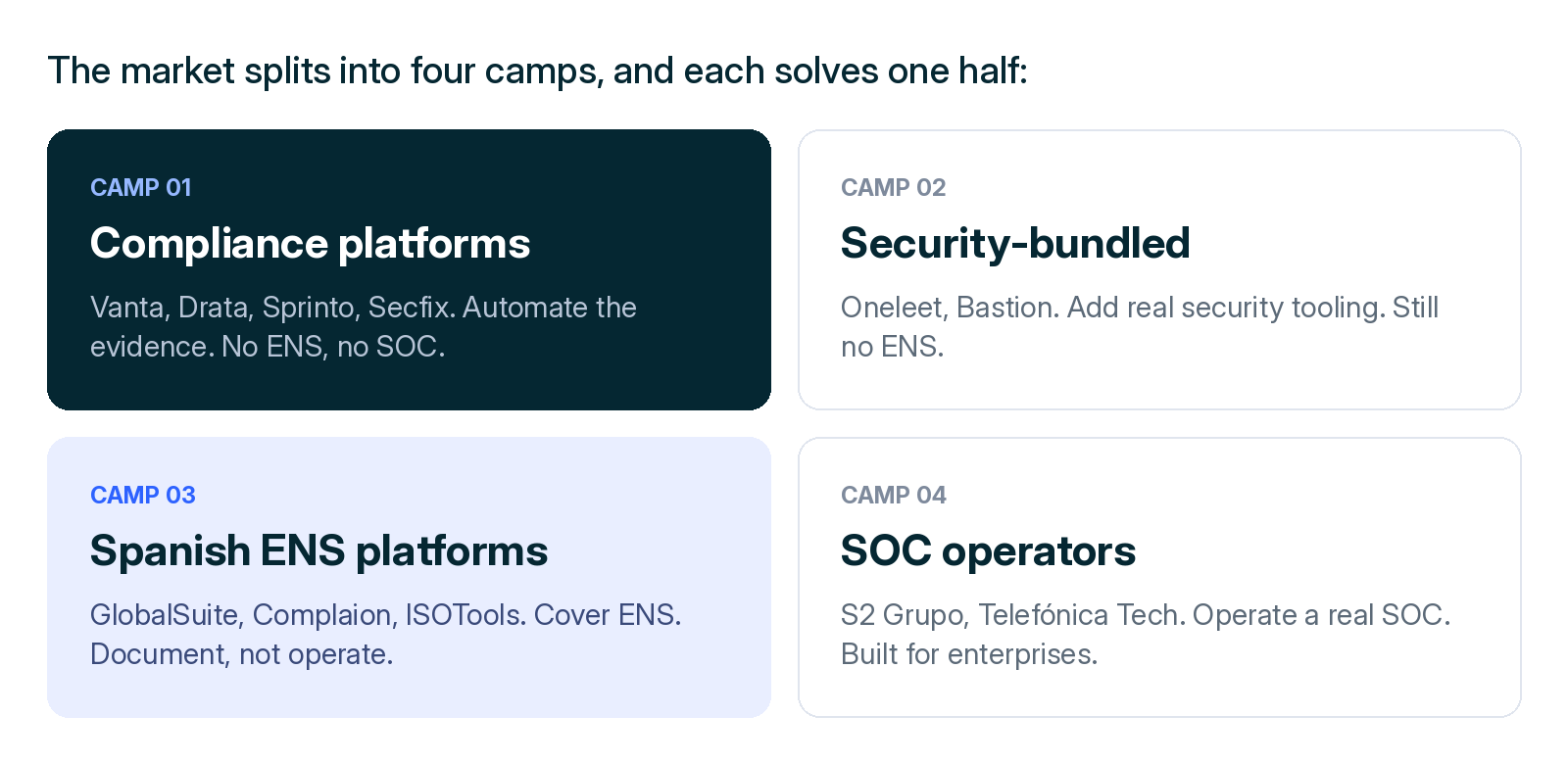
This is the category that created compliance automation, and for what it does, it is genuinely strong. These platforms connect to your stack, collect evidence continuously, generate policies, track tasks and renewals, run a vendor-risk and questionnaire workflow, and publish a trust centre. For a documentation-heavy standard they remove months of manual work, and the best of them are excellent at it.
Vanta is the category leader, with the widest integration library and auditor network in the market and coverage that runs from SOC 2 and ISO 27001 through GDPR, HIPAA and PCI DSS, and more recently NIS2 and DORA. It fits a US-market company that wants to run the work itself on the platform, rather than have it guided and operated for them. Drata is its more extensible counterpart, with an open API, custom controls and an endpoint agent, which technical teams that want to model their own stack tend to prefer. Sprinto is the lean option, built around fast multi-framework control reuse for cloud startups. Secfix is the European entry, focused on ISO 27001, NIS2 and GDPR, with EU auditor relationships and assigned experts rather than software alone. And a newer wave, led by open-source entrants such as Comp AI, offers the same documentation model in a lighter, more self-served form. For a startup or scaleup whose first requirement is a self-served SOC 2 or ISO 27001, whether it sells into the United States or the EU, any of these can be the right answer. Where a Spanish or European company also has to certify ENS, or would rather have its security operated and its certification guided than run them in-house on a platform, that is where Qalea fits: the same compliance automation, paired with an operated security function.
Two things are worth knowing before a Spanish buyer shortlists one. None of them carries ENS, which is a Spanish scheme with a CCN control catalogue that international platforms have not built for. And they document and monitor controls rather than operate the security: they do not run a SOC, triage an alert, or perform the penetration test, by design. So if your requirement is ENS, or you have no internal team to run the controls the platform is documenting, a documentation platform is one part of the answer, and the operated part is still yours to assemble. That operated part is exactly what Qalea runs in-house.
The platforms that build security into the product
A smaller group goes further, putting real security work inside the product rather than documentation alone. Oneleet, founded by career penetration testers, includes an in-house pentest and a vCISO with the platform, and stakes its positioning on the certificate meaning the company is actually secure, not just documented. Bastion, built in France by former Palantir engineers, pairs the compliance platform with security tooling (endpoint, infrastructure and web scanning, phishing simulation) and puts a dedicated security engineer and a vCISO in every tier. Both are a real step up from documentation alone, and for an international startup that wants security built into the certificate, they are a strong, credible choice.
For a Spanish buyer, two things set the choice apart, and neither is a knock on these platforms. Both are international, so ENS and the Spanish regime sit outside their scope by design. And Oneleet in particular shares Qalea's conviction that a certificate should mean the company is genuinely secure. What distinguishes Qalea here is the breadth of what it operates and the locale it operates in. Underneath the compliance platform it runs a staffed 24/7 SOC with SIEM and EDR across laptops and servers, and it covers the whole attack surface as operated modules: external attack-surface and internal vulnerability management, cloud misconfiguration monitoring on AWS, GCP and Azure, application security from commit to runtime, plus phishing-based awareness, device management and a manual pentest, all under one monitoring layer. It covers ENS at all three categories, and it delivers this on a spectrum from guided to fully managed, where Qalea absorbs the operational load of the programme, at the size of a Spanish company of ten to two hundred and fifty. So Qalea sits in this group and in the compliance-platform group at once: the automated compliance platform and the operated security function, run as one.
The Spanish and Italian platforms that cover ENS
If ENS is the requirement, the field narrows to players built for the Spanish regime, and these are the specialists in it. GlobalSuite, a Madrid GRC firm with two decades of public-sector delivery, is ENS-certified itself and CCN-aligned, with deep framework breadth across risk, continuity and privacy: a genuinely strong governance platform, at its best in an organisation that already has a CISO or a risk function to drive it. Complaion, an Italian company running a full Spanish-language ENS practice, pairs its software with a dedicated ISO lead auditor for each client and covers ENS at all three levels: the closest of these to combining a tool with a named expert. ISOTools is a mature management-systems platform where information security and ENS sit alongside ISO 9001 and other standards, which makes it a natural home if you already run your quality systems there.
These cover ENS properly, which the international platforms cannot, and for documentation and governance they are capable. What they share is a documentation focus: they map, evidence and govern the ENS controls, but the SOC, the monitoring and the penetration testing underneath are delivered separately, or not at all. Qalea covers the same ENS ground and operates that security layer as part of the same service.
The Spanish security providers that operate a SOC
At the other end are the firms that clearly do operate security: managed-security providers with their own round-the-clock SOCs, delivering ENS, ISO 27001 and NIS2 as a service. S2 Grupo runs its own SOC and CERT from Valencia with a distinctive IT and OT specialism. Telefónica Tech operates SOCs at telco scale and carries a dedicated GRC and compliance practice. Innotec Security, now part of Accenture, brings an enterprise SOC and cyber-intelligence. Secure&IT runs its own SOC across five service lines and reaches further into the mid-market than the others. Their operated security is the real thing, and for a large enterprise or a public administration they are a sound choice.
The difference for a smaller company is scale and shape, not quality. These are enterprise and public-administration providers, delivered as consulting engagements through procurement, and they do not pair that operated security with a self-serve compliance platform that automates your evidence. Qalea offers the same operated security with the automated compliance platform alongside it, sized for a mid-market company rather than an enterprise.
Where that leaves a Spanish SME
Line the groups up and the shape is clear, and none of it needs a competitor to look bad. The compliance platforms are excellent at automating evidence, and outside the Spanish players they do not cover ENS or operate security. The Spanish security providers run a real SOC, and are built for enterprises rather than a fifty-person company, without an automated compliance platform alongside. The Spanish ENS platforms cover the ENS documentation well, and leave the security to be operated elsewhere. Put plainly, and it is the useful fact in this whole comparison: none of the compliance platforms runs a SOC, and none of the Spanish security providers automates the evidence.
Qalea is built to close that gap: an automated compliance platform, ENS at all three categories, and an operated security function, in one place and sized for a company of ten to two hundred and fifty people. Each of the tools above is a good answer to part of the problem for the company it was built for. For a Spanish mid-market company that has to certify and has no security team to run the controls, the stronger answer is the one that covers the Spanish frameworks and operates the security at the same time.
How Qalea is built
Qalea is organised around three coordinated areas over one continuous monitoring layer. Every capability below is a live part of the platform.
Processes, the compliance layer. The Qalea platform is a digital ISMS: one environment for ISO 27001, ENS, NIS2, DORA, SOC 2 and ISO 42001, with risk management, supplier management and questionnaires, identity governance, automated evidence and a continuously audit-ready state. Certification support runs from guided (internal audit, onboarding, unlimited support) to Fully Managed, where Qalea absorbs the operational load of the programme so your team only appears when it has to. A vCISO adds senior judgement for architecture, due diligence and the client security questionnaires a platform cannot answer.
People, the human layer. Awareness combines real phishing simulations with continuous, measurable training inside the same platform. EDR protects and monitors every laptop and server across Windows, macOS and Linux, with hardening. MDM manages devices, and a password manager closes a common gap.
Infrastructure, the technical layer. External attack surface management shows what an attacker sees from outside, including exposed assets, expired certificates and leaked credentials. Vulnerability management finds the internal CVEs on servers and hosts. Cloud protection catches the misconfigurations in AWS, GCP and Azure that cause most cloud incidents. Application security runs SAST, DAST, SCA, secrets scanning and SBOM from commit to runtime. Manual penetration testing goes deeper than any scanner.
Underneath all of it, EDR, SIEM and a SOC provide continuous monitoring and incident response, so detection and response are operated, not assumed.
The benefit against a documentation-only platform is concrete. Where a platform's job ends at the evidence pack, Qalea's SOC triages the alert, the pentest finds the exposure, and the vCISO handles the questionnaire and the judgement calls. And where the global platforms cannot certify ENS at all, Qalea delivers it at all three categories. Qalea helps companies become audit-ready and runs the security function that keeps a certificate valid. It does not issue certificates and is not a certification body.
One honest boundary: Qalea is not a catalogue of hundreds of frameworks. It covers the frameworks a Spanish mid-market company has to certify, ISO 27001, ENS, NIS2, DORA and SOC 2, plus ISO 42001 for AI governance, and operates the security underneath them, rather than documenting many frameworks shallowly. If your requirement today is HIPAA or TISAX, that is not the current fit.
The 2026 compliance checklist for a Spanish company
Not every item applies to every company, but this is the shortlist to map this year, each with a named legal source.
- ISO 27001 and, where relevant, ENS. The certifications customers and public tenders request. ENS (RD 311/2022) applies to suppliers handling public-sector information systems, at the category the tender sets.
- NIS2 risk management and incident notification, if in scope. NIS2 (Directive EU 2022/2555) reaches essential and important entities in eighteen sectors with fifty or more employees or more than ten million euros in turnover. Spain missed the October 2024 transposition deadline, and the Ley de Coordinación y Gobernanza de la Ciberseguridad that completes it was still in Parliament in mid-2026, with partial transposition already in force via Real Decreto-ley 7/2025. The duties already apply, because they come from the directive itself.
- GDPR and LOPDGDD privacy records. The RGPD (Regulation EU 2016/679) and LOPDGDD (Ley Orgánica 3/2018) require your records of processing, privacy logs and a breach-notification process.
- Whistleblower channel. Ley 2/2023 requires private entities with fifty or more employees to run an internal reporting channel.
- Continuous monitoring underneath all of it. NIS2, ISO 27001 and ENS all assume you can detect and respond, not only document. That is the EDR, SIEM and SOC layer.
One item that gets swept into this list does not belong on it. VeriFactu is a fiscal e-invoicing obligation under RD 1007/2023 and the anti-fraud law (Ley 11/2021), not a security framework, and Real Decreto-ley 15/2025 deferred it to 1 January 2027 for companies and 1 July 2027 for the self-employed. Billing and fiscalisation vendors handle it, on a separate track.
How to choose
Start from the two questions, not from a brand.
- SOC 2 first, selling to United States customers: a global automation platform is built for you. Choose on integrations, support and fit.
- ISO 27001 for European customers, no ENS, and you already run your own security: a European automation platform covers ISO 27001 with NIS2 and DORA and keeps your data in the European Union.
- ISO 27001 or ENS, and no internal team to operate the controls: you need Spanish framework coverage plus operated security in one place. That is the narrow set where Qalea sits, and where a global tool leaves you assembling the SOC, the pentest and the vCISO yourself.
Whatever you shortlist, ask three questions on the demo: does it cover ENS at the category my tenders require; is any security operation included, or is that my job; and where is my compliance data stored. The answers separate the categories in minutes.