
The main difference
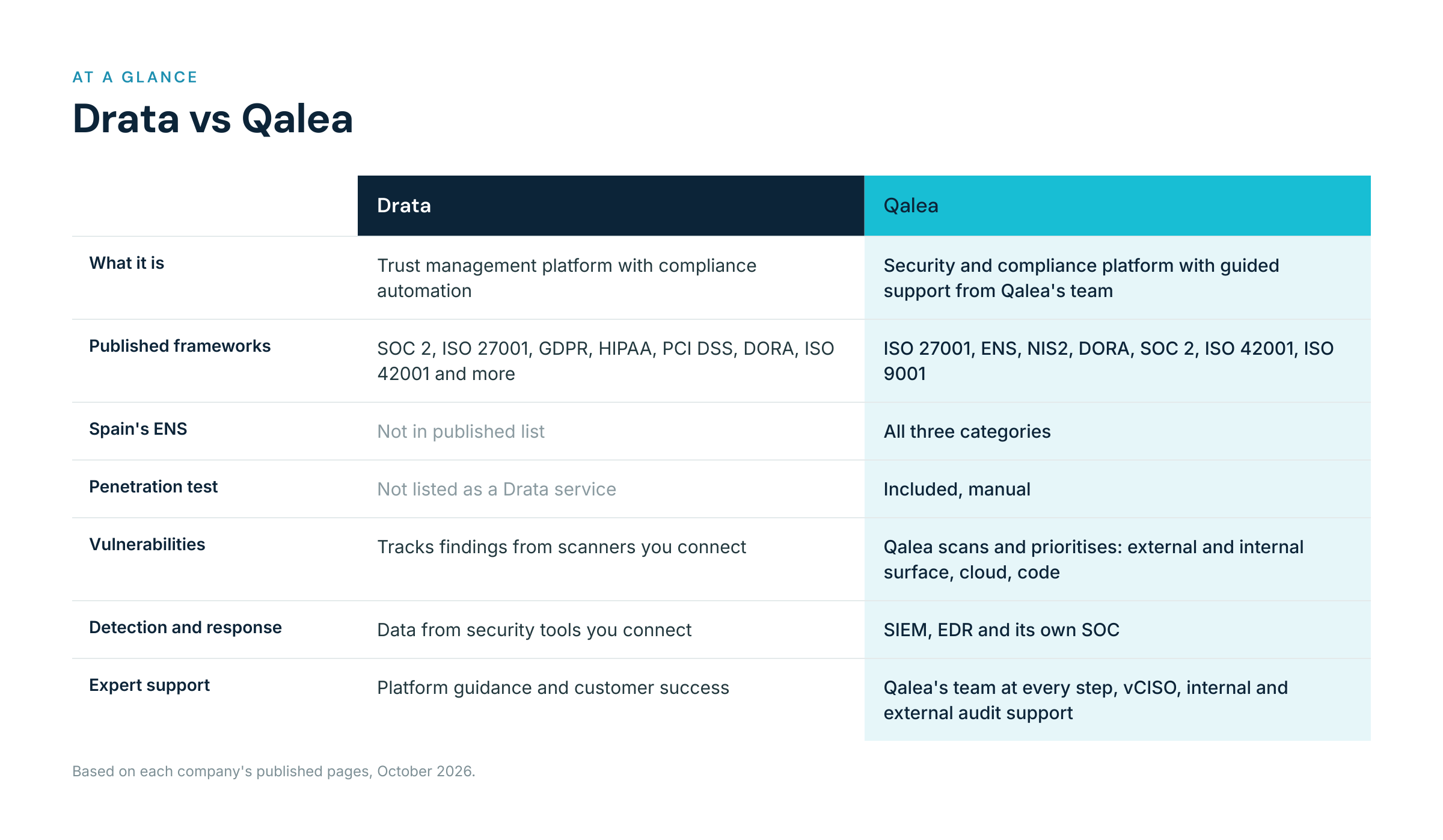
Drata describes itself as a trust management platform. It automates evidence collection and control monitoring across more than 30 prebuilt frameworks, including SOC 2, ISO 27001, GDPR, HIPAA, PCI DSS and DORA, and lets you share your status through a Trust Center. Security data comes from the tools you connect: Drata tracks vulnerability findings from scanners such as CrowdStrike, Microsoft Defender, SentinelOne or Tenable and sets deadlines to fix them, but the scanning, testing and threat response are done by those tools and the providers you choose.
Qalea also automates compliance, and adds guided support from Qalea's team at every step: preparing the documentation, setting up and maintaining the controls, and getting ready for the audit. Penetration testing, vulnerability scanning and continuous monitoring are part of the platform, so security and compliance are managed in one place. Certification is issued by an accredited certification body, never by Qalea or Drata.
Who does the work, stage by stage
Both platforms collect evidence automatically. What changes is who carries out each stage of the certification and who keeps it running afterwards.
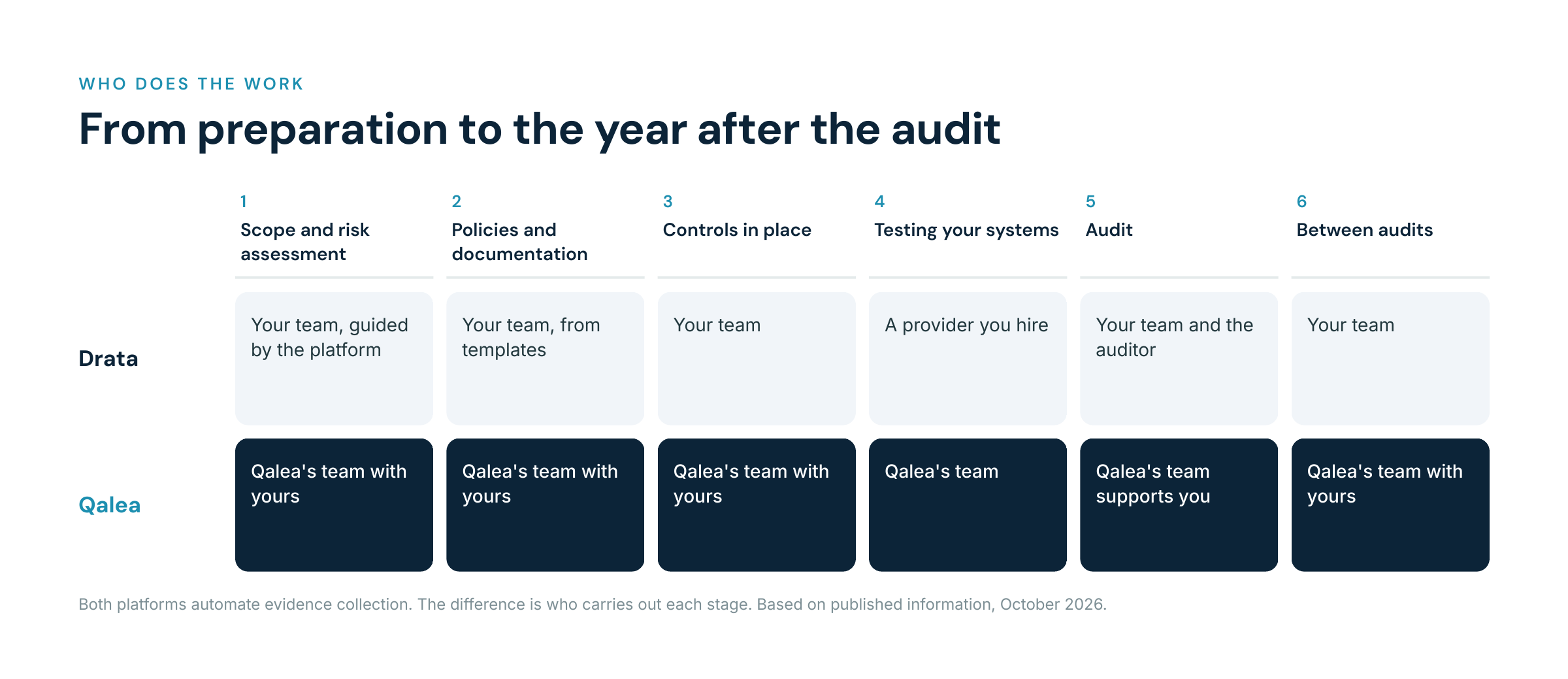
- Scope and risk assessment. With Drata, your team defines the scope and assesses risk, guided by the platform. With Qalea, Qalea's team runs this with you.
- Policies and documentation. With Drata, your team adapts the policy templates and keeps them current. With Qalea, the documents are prepared with you and kept up to date with Qalea's team.
- Controls in place. With Drata, your team implements the controls the platform monitors. With Qalea, Qalea's team helps put them in place and keeps them running.
- Testing your systems. With Drata, you hire a provider for penetration testing and connect your own scanners. With Qalea, the testing and scanning are included and run by Qalea's team.
- Audit. With Drata, your team works with the auditor. With Qalea, Qalea's team supports you through the audit.
- Between audits. With Drata, your team keeps the program running. With Qalea, Qalea's team works with yours so the controls keep operating for the next surveillance audit.
If you already have a security team
Many companies that use Qalea have their own security team. In that case Qalea's team works alongside it. Qalea takes on the operational work: penetration testing, vulnerability scanning, continuous monitoring through its SOC, evidence collection and audit preparation. Your team keeps ownership of decisions and priorities, and spends its time on the risks specific to your business instead of on running tools and gathering evidence.
What Qalea includes beyond compliance
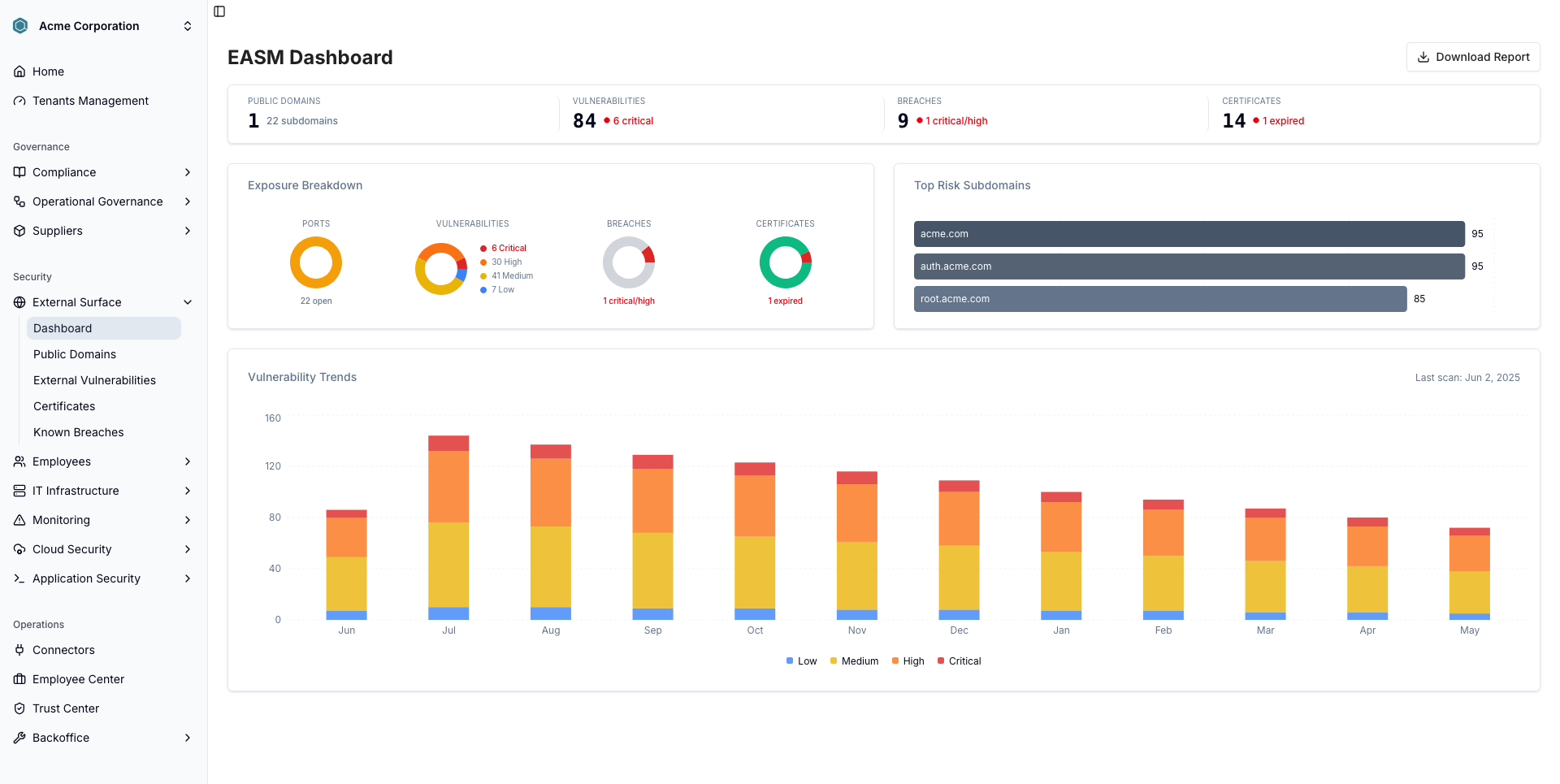
Qalea's platform covers three areas under continuous monitoring.
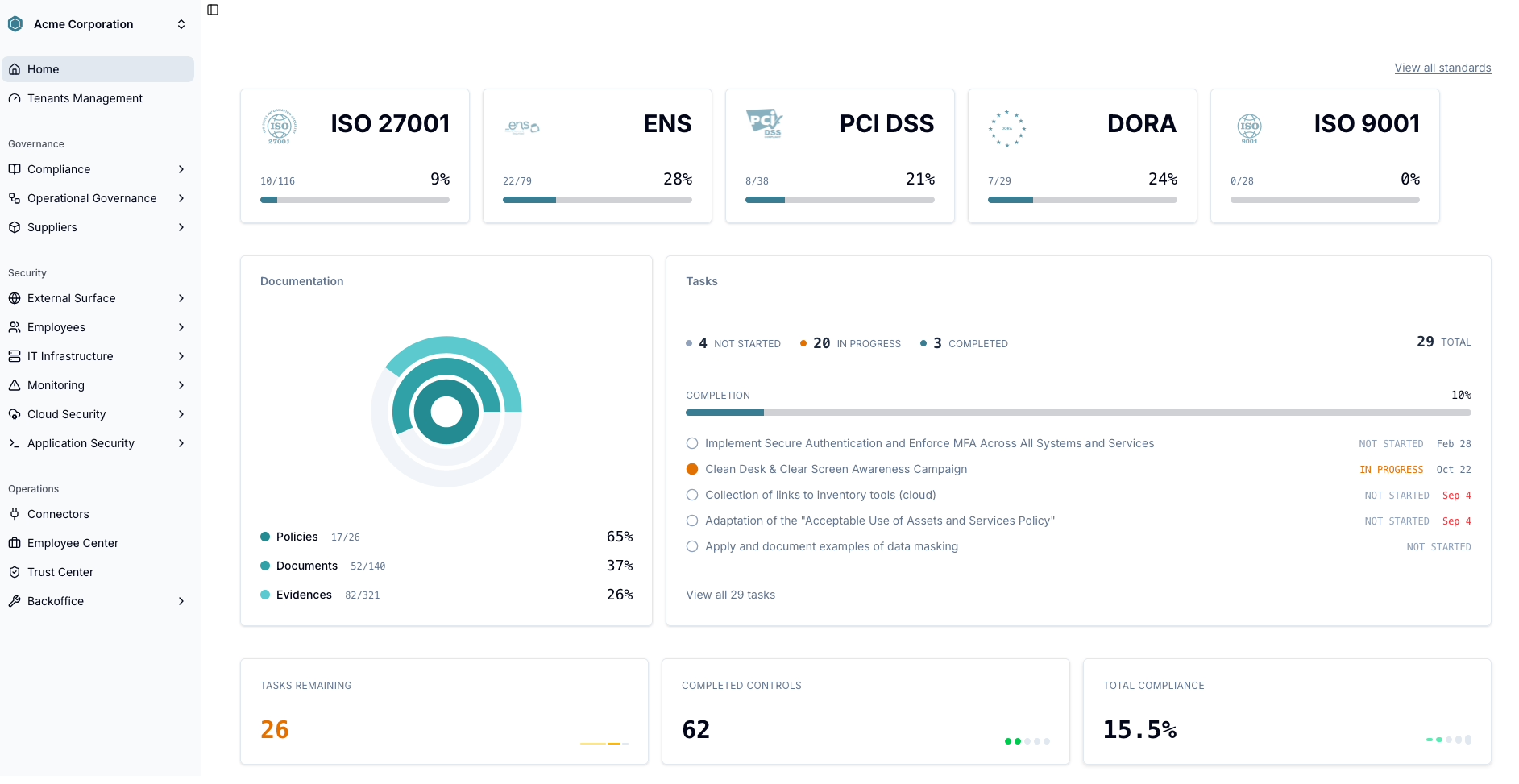
- Processes. ISO 27001, ENS, SOC 2, NIS2 and DORA, with policies, risk management and audit support.
- People. Awareness training, phishing simulations, EDR and device management on laptops, and a password manager.
- Infrastructure. External and internal attack surface, cloud and code, with vulnerabilities prioritised by real risk.
Who each one suits
Drata is usually the better fit if:
- you have a technical team that wants to extend the platform with its own controls and tests
- you already run your own security tools and providers and need a platform to collect their evidence
- you need US frameworks such as FedRAMP or HITRUST
Qalea is usually the better fit if:
- you have a security team and want it focused on decisions, not on running tests, monitoring and evidence
- you have an IT lead but no one whose job is security
- you want compliance, penetration testing and monitoring from one provider
- you need Spain's ENS for public sector contracts
- your certification project has stalled or your certificate is at risk
What Drata does well
Drata offers more than 30 prebuilt frameworks with controls mapped across them, so evidence collected for one framework counts towards others. Technical teams can add custom controls and tests through its API, and it connects to a wide range of security tools, from endpoint protection to vulnerability scanners, to turn their data into audit evidence. Its Trust Center lets you share your compliance status with customers. For a company that already runs its own security stack and wants one place to evidence it, that is a real strength.
When Qalea is the better choice
Qalea fits midsize companies that need to certify, whether or not they have their own security team. With a security team, Qalea's team works alongside it and takes on the operational work. Without one, Qalea's team guides each stage. In both cases compliance, testing and monitoring sit in one platform instead of with several providers, and the controls keep operating through yearly surveillance audits.
Moving from Drata to Qalea
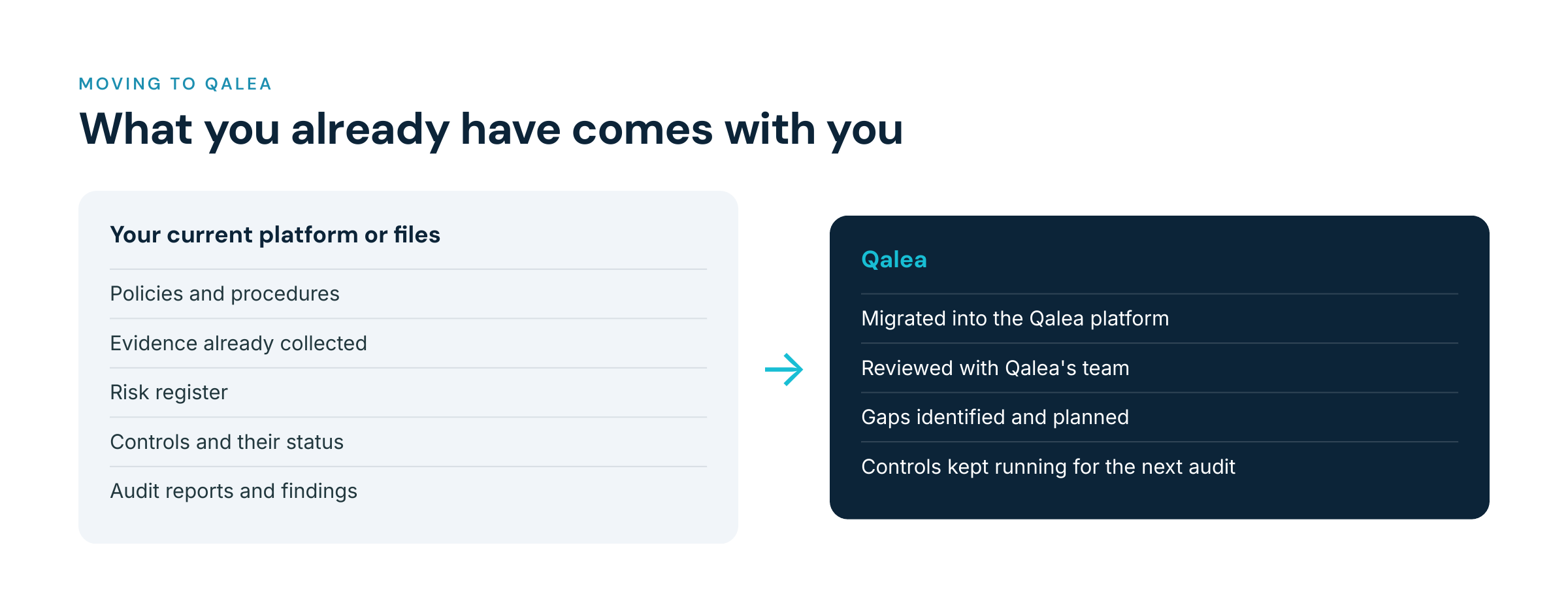
Changing platform does not mean starting again. Qalea migrates what you already have into the Qalea platform: policies and procedures, evidence already collected, the risk register, your controls and their status, and previous audit reports. Qalea's team then reviews it with you, identifies any gaps and plans the work before the next audit.
Comparing the total cost
A platform licence is one line in the budget. To compare like with like, add what the licence does not include:
- penetration testing engagements
- vulnerability scanning tools
- security monitoring and response
- endpoint protection and device management
- someone in charge of security
- the internal hours your team spends running all of it
Qalea's price covers that whole set. Compare the full stack, not the licence alone. For a wider view of the options, see How to choose your security and compliance setup, what a compliance platform does not do and our comparisons of Qalea with Vanta and Sprinto.
Questions to ask any provider
- After the platform is set up, how much of the work stays with our team?
- Is penetration testing included, or bought separately?
- Who scans for vulnerabilities, and who fixes what they find?
- Who watches for threats, and who responds if something happens?
- Who is in charge of our security, and who do they answer to?
FAQ
Is Qalea a Drata alternative?
Yes. Both are security and compliance platforms. Qalea adds guided support from its own team, penetration testing, vulnerability scanning and continuous monitoring, whether your company has its own security team or not.
Does Drata include penetration testing?
Penetration testing is not listed among Drata's own services as of October 2026. Drata tracks findings from the security tools you connect. Qalea includes manual penetration testing in its platform.
Does Drata cover Spain's ENS?
The ENS does not appear in Drata's published list of frameworks as of October 2026. Qalea covers the ENS in all three categories: basic, medium and high.
Can I move from Drata to Qalea without starting again?
Yes. Qalea migrates your existing policies, evidence, risk register and controls into its platform, then reviews them with your team before the next audit.
Can Qalea or Drata certify my company?
No. Certificates such as ISO 27001 are issued by accredited certification bodies after an audit. Platforms prepare companies for the audit and help keep controls running afterwards.
Does Qalea work with ISO 27001 and SOC 2 at the same time?
Yes. Qalea works with ISO 27001, the ENS, SOC 2, NIS2 and DORA in one platform, so controls shared across frameworks are managed once.